

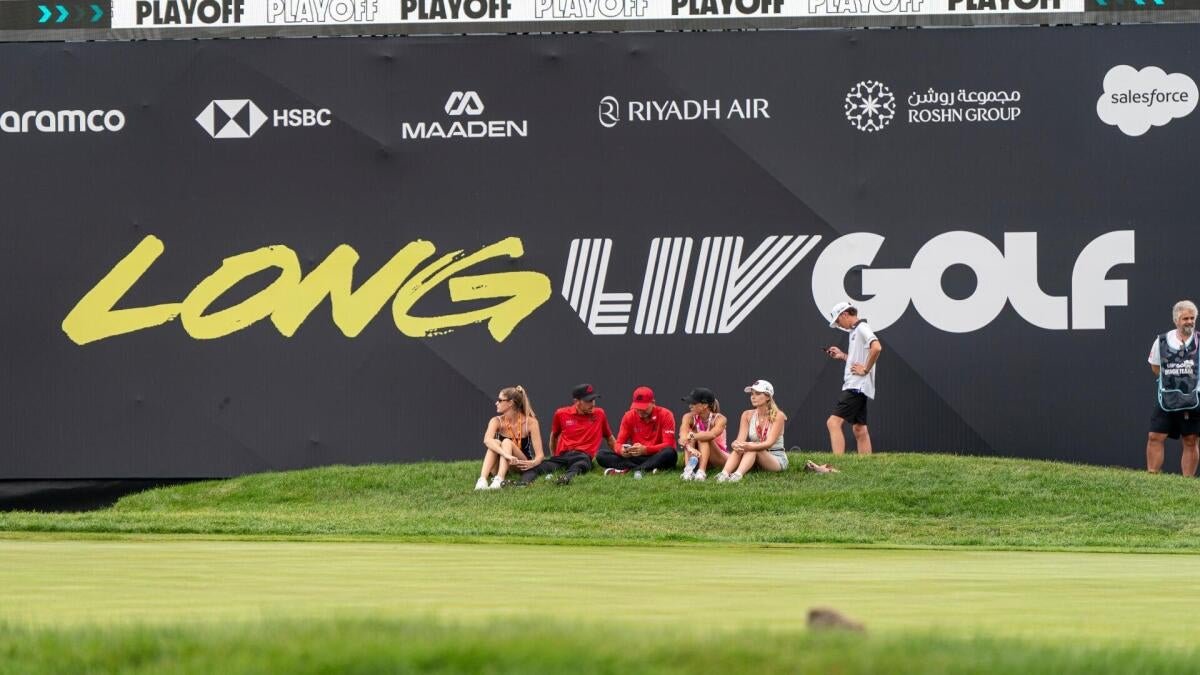

Five years after launching and attempting to punch a hole in the professional golf ecosystem by promising massive purses and attempting to poach the biggest names in the sport, LIV Golf is officially shutting down.
Saudi Arabia’s Public Investment Fund announced earlier this year that it would pull all its funding for the league after the 2026 season, ending its investment after sinking more than $5 billion into LIV Golf since its launch. After filing for Chapter 11 bankruptcy protection and failing to secure a new financial backer willing to see “LIV Golf 2.0” through to launch, the fledgling league is in the process of closing its doors for good.
LIV then attempted to find a path forward by relaunching LIV 2.0 after filing for bankruptcy, but struggled to convince top players to stick with the league as they shifted from massive purses and guaranteed money to offering equity in a fledgling league.
On Wednesday, word broke that BC Partners decided to pull its planned $300 million investment in LIV Golf’s relaunch after the league failed to secure enough players, pushing the circuit towards extinction. On Thursday, LIV Golf confirmed it would begin a “wind-down of its operations” at a previously scheduled hearing in New Jersey Bankruptcy Court.
There is plenty to unpack about LIV Golf’s short stint as a disruptive force in the golf world, as well as what is to come for the handful of notable players who left the PGA Tour for the promise of guaranteed riches but now face uncertain futures.
What happens to LIV Golf’s top players?
With Brooks Koepka defecting from LIV Golf ahead of the 2026 season — accepting a one-time offer from the PGA Tour to return to the league under penalty — the most notable free agents are Jon Rahm and Bryson DeChambeau. However, others like Tyrrell Hatton, Joaquin Niemann and Tom McKibbin present some intrigue for fans.
While only Koepka accepted the PGA Tour’s prior offer, the circuit showed a willingness to work with top stars if they were willing to accept penalties as part of being brought back into the field. However, Rahm and DeChambeau turned down the opportunity to bolt LIV Golf alongside the five-time major winner, and the PGA Tour has made clear that the same Returning Member Program will not be available to them.
Koepka’s deal — including a $5 million charitable donation, ineligibility for the Player Equity Program for five years and no FedEx Cup payouts in his first year back — was termed as “not precedent-setting.” Given players like Rahm, DeChambeau, Hatton and Niemann now have little leverage in talks, it’s fair to presume they’ll be offered a different deal that could be significantly more punitive — if they are offered a deal at all.
The path they’ll all be afforded is the one Patrick Reed took: serve a one-year suspension from his final LIV Golf start before returning to the PGA Tour with whatever status he could earn via major championship qualification and competition on the DP World Tour.
Rahm has already worked out a deal to exit LIV Golf, which is expected to be finalized Thursday. He plans to take the DP World Tour path — as do the likes of Hatton and most others — if the PGA Tour doesn’t make him an offer, but those bigger names hope to work out some kind of deal to rejoin the PGA Tour in 2027.
Unlike Koepka, who had to try and play his way back into signature events (he failed to do so in 2026), Rahm and DeChambeau would still have full status when they return, given they have major championship victories in the last five years.
The PGA Tour could look to create another accelerated pathway to bring those two back into the fold sooner, but after turning down that opportunity earlier this year — and DeChambeau steadfastly remaining dedicated to LIV Golf after the fact — the Tour may not want to make it so easy, especially considering the temperature of its player membership.
What DeChambeau plans to do is a much bigger mystery than Rahm’s, particularly given Bryson’s complicated relationship with the PGA Tour.
DeChambeau was part of the group that filed an antitrust lawsuit against the PGA Tour after defecting to LIV Golf. While that lawsuit was ultimately dropped, it led to escalating tensions between the two sides, and PGA Tour CEO Brian Rolapp admitted to the Wall Street Journal that “scar tissue” would come into play.
“I don’t necessarily have scar tissue, but there are plenty of people around our tour who do,” Rolapp said earlier this year. “It has to be accounted for in some shape or form.”
There is always the third path for DeChambeau: become a full-time YouTube golfer who plays in majors for as long as he has exemptions as a past champion.
For others, the road back to PGA Tour status will be more arduous. With the circuit preparing to shift its membership into the Championship Series and Challenger Series beginning in 2028, gaining status on the top level of the PGA Tour will be harder than ever — especially for those who miss out on the 2027 season and the associated opportunities to secure exemptions onto the Championship Series.
The lack of world ranking points for LIV Golf players until this year means few will have clear status as they try to return to the PGA Tour after a lengthy absence, and many players don’t even have guaranteed status on the DP World Tour for 2027. Some, like Thomas Pieters and Josele Ballester, are currently fighting through DPWT Q-School’s final stage to try and earn their card.
Some LIV players may qualify for the PGA Tour’s “past winners” provision once their suspensions are up, which provides some access, but only to smaller events.
The harsh truth is that the PGA Tour won’t be particularly enamored with most of the players who made up the LIV Golf roster, many of whom were past their prime when they left five years ago.
“We’re interested in having the best players who can help our tour,” Rolapp explained bluntly. “Not every player can do that.”
That means, in an ironic twist, those who left for the guaranteed money on LIV will now have to truly earn their way back onto the PGA Tour by playing their way into status, yet not everyone has a clear path back.
Ambitious yet flawed
When LIV Golf first began, it appeared to present an existential threat to the PGA Tour. With billions of dollars in backing from the PIF, the league was aggressive in pursuing many of the game’s top stars with lucrative nine-figure deals. Greg Norman was the public head of the venture with Phil Mickelson becoming the early face of the league — and stirring up almost-immediate controversy.
While LIV Golf was most successful in bringing in older players early, it was able to coax only a few top, younger stars to join the league with promises of guaranteed money and a shortened global schedule.
Dustin Johnson was among the first to sign on, followed by DeChambeau, Koepka, Reed and Niemann. Cameron Smith defected shortly after capturing his first major victory at the 2022 Open Championship. All of whom helped the league some legitimacy beyond being a retirement tour for former stars like Mickelson, Sergio Garcia, Henrik Stenson, Louis Oosthuizen and others.
The biggest shockwave came after LIV Golf’s second season, when Jon Rahm, who repeatedly denied any desire to join LIV Golf, bolted from the PGA Tour in December 2023 after reportedly receiving an offer worth over $300 million. This came months after the infamous “framework deal” between the PIF and the PGA Tour, which seemed to indicate that a potential merger could be on the horizon.
However, after nothing materialized from that framework, LIV Golf poached Rahm, potentially in an attempt to show the PGA Tour it could acquire even more stars with its seemingly endless money fun.
However, few others of note made the jump to LIV after Rahm. Hatton joined Rahm’s newly formed team, but otherwise, LIV continued to struggle bringing over the rest of the PGA Tour’s best — particularly American-born stars who weren’t as keen on a global travel schedule.
It did push the PGA Tour to create signature events, increase purses and explore additional avenues of revenue generation, but at the end of the day, with Tiger Woods and Rory McIlroy leading the way, the PGA Tour was never under imminent threat of losing its place atop the sport.
LIV Golf billed itself as a league that would push golf forward with a team concept, 54-hole events with a shotgun start and a party atmosphere. However, none of that truly landed with fans. The most unique part of LIV Golf — its best chance at truly carving out something interesting — was the team concept, but the way the league went about team play — each player’s individual scores being added together for a team result rather than leaning in more with match play — didn’t make it feel like a team sport at all.
The end as we know it …
LIV Golf’s facade began to crumble late in 2025 when Koepka suddenly announced he reached an agreement to end his contract a year early and become a free agent. He was quickly brought back in by the PGA Tour, signaling that the circuit would be more open LIV Golf stars who wanted to return under Rolapp’s leadership.
Reed became the second notable player to announce plans to return to the PGA Tour after his contract ran up at the end of 2025, playing a full DP World Tour schedule in 2026 prior to regaining full status back on the PGA Tour in 2027.
DeChambeau, Rahm and Smith were offered the same deal as Koepka but declined; Rahm had two years left on his deal, and DeChambeau was in the midst of a contract year. Retaining Rahm and DeChambeau appeared necessary for LIV Golf to maintain any relevance, as its efforts to cultivate young stars had not yet materialized in a meaningful way, and the aging veterans were no longer factors on the major championship stage.
To try and keep their top stars happy, better prepare players for majors and earn world rankings points the league had previously been denied, LIV Golf expanded to 72-hole events in 2026. However, while Rahm appreciated the move, DeChambeau wasn’t as excited about the change, noting that it wasn’t what he had initially signed up for.
Despite concerns about their future, Rahm and DeChambeau dominated the early portion of the 2026 season with two wins each — despite a woeful performance from both at the Masters to begin the major championship season.
Most anticipated that DeChambeau’s decision on whether to re-sign would determine LIV Golf’s future as a viable league. Losing DeChambeau would have left them with one genuine star in Rahm, who most expected would depart once his deal ran out.
LIV Golf produced some successful on-site events, such as those in South Africa and Australia, but the global schedule and lack of star power made it hard to create a strong TV product, and viewership never grew substantially, especially in the United States. That led to constant questions about the league’s long-term viability and whether it was having the intended impact for the PIF, given the level of investment it had put in.
Even with those questions, few anticipated such a swift end to the experiment. However, citing the war in Iran, the PIF opted to pull the plug earlier than anyone expected. LIV Golf CEO Scott O’Neil attempted to keep things together and build a leaner LIV Golf 2.0 with BC Partners, but the problem they ran into is that the players that were intrigued by the opportunity LIV Golf 1.0 presented — mainly in the form of massive, guaranteed money — aren’t the types interested in building something from scratch with little safety net.
Equity in a new league wasn’t enough to intrigue most of the league’s top stars, and while some like DeChambeau were interested in launching something new, without others to raise their profile, it was tough to latch on as one of the only major names. As such, LIV Golf will end with a whimper rather than a bang, and the golf world is left to try and figure out what the last five years meant.
LIV Golf’s legacy
LIV Golf will be remembered by most as a failed, extremely expensive experiment.
The attempts to make something new and loud felt forced — being different for the sake of being different. The party atmosphere, shotgun start and 54-hole events never landed with the majority of golf fans. The team golf concept never caught on either, largely because it never felt like team golf.
There were some successes, particularly in tapping into some global markets that are not well served by the PGA Tour.
What’s ironic is that Mickelson’s initial desire to reshape the structure of the PGA Tour — when denied, he got in bed with LIV Golf — will be the rival league’s legacy.
“Competition makes you better,” Rolapp said in a recent interview, comparing LIV Golf to the AFL and USFL in how those leagues pushed the NFL to improve its business. “Whenever you get competition, you figure out what you do well and what you don’t do well. … In a lot of ways, I think LIV did the professional golf world a favor.”
The PGA Tour built a for-profit arm to attract more investment and funnel additional money into the PGA Tour. The creation of signature events is directly correlated to LIV Golf’s massive purses, as the PGA Tour tried to ensure top players had opportunities to make more money.
In the next two years, the PGA Tour’s entire scheduling structure will change. Woods has been at the helm of creating a new two-tier structure that will feature their top stars playing in more major markets in the Championship Series with the Challenger Series serving as a promotion/relegation system.
All of these changes resulted from LIV Golf pushing the PGA Tour to reconsider the status quo. The disruption attempt worked, in a way, but not in the way LIV Golf hoped.
Instead of drawing most of the top stars — and thus fans — away from the PGA Tour, LIV GOlf gave the Tour an impetus to make changes to push the sport forward, while still leaning on the tradition and history that has built-in resonance with fans and sponsors.
LIV Golf could never make enough inroads in any of their ventures to create a real foothold in the game of golf, and as a result, it will end up as something closer to a footnote in a fascinating and important era of professional golf’s history.
